Constant Feeling of Dread for No Clear Reason: 7 Patterns to Notice and How to Ease the Weight
A gentle, non-clinical guide to noticing what background dread resembles, what may be connected, and where reflection can begin.
Direct Answer
A constant feeling of dread does not necessarily mean something bad is about to happen. Sometimes it develops when pressure, uncertainty, emotional weight, or unfinished situations leave you feeling internally braced even when you cannot identify one immediate threat. The feeling is real, while the explanation may still be forming.
People often describe this as a constant sense of dread or a feeling of dread for no reason. In this guide, ‘no clear reason’ means that the connection may not yet be obvious—not that one hidden explanation must always exist.
When Dread Stays in the Background
You may wake already feeling heavy, unsettled before you have even checked your phone. During an ordinary moment, your stomach may sink without a clear thought attached. The room is calm, but you cannot quite settle inside it.
You may feel unexpected relief when plans are cancelled, as though part of you had been preparing to carry one thing too many. You still answer messages, meet responsibilities, and move through the day, yet a background heaviness follows you.
That experience can be difficult because nothing obvious seems to explain it. You may look for one event to blame while the feeling remains low, recurring, and hard to put into words.
Is This Background Dread, Anticipatory Dread, or Sudden Alarm?
These are descriptive differences, not diagnostic categories. They can help you choose the guide that most closely resembles the moment.
Background Dread
A low or recurring feeling that remains without one clear event explaining it.
Anticipatory Dread
A feeling linked to something specific that is expected, such as a meeting, decision, conversation, journey, or difficult day.
Sudden Alarm or Sense of Doom
A more immediate and intense feeling that something terrible may be happening or about to happen.
This guide focuses on the first pattern: dread that stays in the background without one obvious event explaining it. For a broader exploration of the word, see What Does Dread Mean?
Why Can Dread Feel as Though It Has No Reason?
“No reason” may mean that no reason is currently clear. The feeling might connect to several smaller pressures rather than one dramatic event. The connection may be indirect, unfinished, difficult to admit, or not yet clear enough to express.
The absence of a clear explanation is not the same as the absence of a pattern. This does not mean every feeling has one hidden cause waiting to be uncovered. It is also possible that none of the patterns below will fully fit.
Seven Patterns to Notice
The following patterns are possible reflective starting points. They are not proven causes, and more than one—or none—may resemble your experience.
1. Too Many Things Remain Unfinished
What it can feel like: Your attention keeps circling back to messages, decisions, conversations, or responsibilities that have not reached an ending.
What may be connected: Several mental open loops may keep a quiet sense of incompletion present even when you are focused elsewhere.
One question to ask: What keeps returning because it has not reached an ending?
One gentle first step: Name one open loop that can be completed, scheduled, delegated, or consciously postponed.
2. Too Much Feels Uncertain
What it can feel like: Your mind repeatedly scans ahead, looking for an answer that has not arrived.
What may be connected: Waiting for an outcome around work, money, relationships, or plans can make the future feel continuously present.
One question to ask: What outcome am I repeatedly waiting for?
One gentle first step: Separate what can be acted on today from what cannot yet be known.
3. You Are Functioning but Never Fully Settling
What it can feel like: You keep performing, solving, and meeting expectations, but rest never feels complete.
What may be connected: Functioning can hide pressure without resolving it. Coping well on the outside may leave little room to notice what the pace costs you.
One question to ask: When did managing everything become the same thing as feeling okay?
One gentle first step: Identify one part of the day in which you are not required to perform, solve, explain, or produce.
4. Something Ended Without Emotionally Settling
What it can feel like: Life moved on after a change, conflict, disappointment, or ending, yet its emotional tone still follows you.
What may be connected: An event can be finished outwardly while part of the experience remains difficult to acknowledge or express.
One question to ask: What changed outwardly, but still feels unfinished inwardly?
One gentle first step: Name the emotional part of the experience that did not receive enough room or acknowledgment.
5. The Day Contains a Constant Stream of Pressure
What it can feel like: Alerts, messages, news, demands, and scrolling keep returning urgency to moments that might otherwise feel quiet.
What may be connected: Repeated pressure input can leave little uninterrupted space to notice what you need.
One question to ask: What keeps bringing urgency back into otherwise quiet moments?
One gentle first step: Reduce one recurring source of unnecessary pressure for a defined period.
6. Your Own Needs Keep Being Postponed
What it can feel like: Rest, space, nourishment, boundaries, or support always seem to come after everything else.
What may be connected: Continually treating a basic need as optional might add heaviness or reluctance to ordinary parts of the day.
One question to ask: What need do I keep treating as optional?
One gentle first step: Restore one small need involving rest, space, boundaries, nourishment, or support.
7. The Body Signal Appeared Before the Explanation
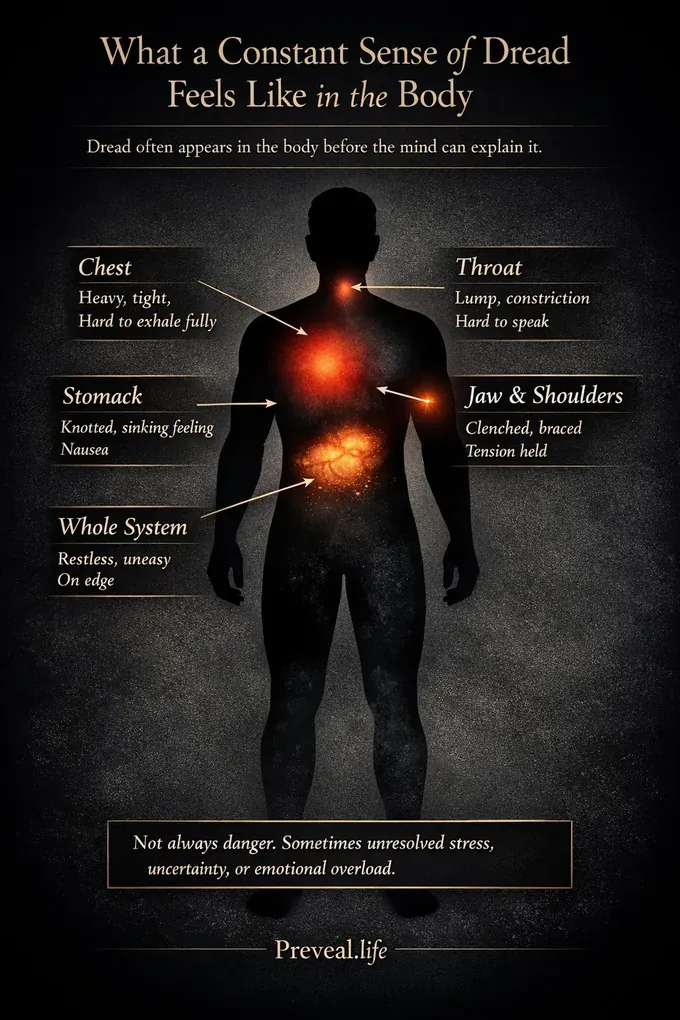
What it can feel like: You notice a sinking stomach, a tight throat, heavy chest, tense shoulders, or another sensation before you know what the moment means to you.
What may be connected: Sometimes sensation becomes noticeable before the emotional tone or nearby life context is clear. First noticed is not always first started.
One question to ask: Where does the feeling appear, and what is usually happening around the time it becomes stronger?
One gentle first step: Notice the body signal, the emotional tone, and the life context without forcing a final explanation. This is the reflective sequence used by the Preveal Body Signal Framework.
Seven-Pattern Summary
A useful first step is usually small and matched to what the experience most closely resembles.
| Pattern | What it can resemble | A gentle first step |
|---|---|---|
| Unfinished matters | Mental open loops | Name one unfinished item |
| Uncertainty | Repeated future scanning | Separate action from what cannot yet be known |
| Functioning without settling | Coping while remaining internally braced | Create one non-performing space |
| Emotional carryover | The event ended but its emotional tone remained | Name what did not settle |
| Constant pressure input | Urgency keeps returning | Reduce one repeated input |
| Postponed needs | Rest, space, or support keeps being delayed | Restore one neglected need |
| Body signal first | Sensation appears before explanation | Notice signal, tone, and context |
How Can You Ease the Weight of Constant Background Dread?
The first useful step depends on the pattern. An unfinished responsibility may need a decision. Constant input may need less exposure. Emotional carryover may need acknowledgment. An unclear body signal may need observation before action.
Reduce Immediate Physical Bracing
- Let the shoulders lower slightly.
- Unclench the jaw.
- Place both feet on the floor.
- Take one longer exhale than usual.
Reduce Mental Open Loops
- Write down what remains unfinished.
- Decide what needs action, scheduling, delegation, or release.
Reduce Unnecessary Pressure Input
- Step away from one repeating source of urgency.
- Create a short period without news, alerts, messages, or scrolling.
Create Room for Interpretation
- Ask what has been quietly building.
- Notice when the feeling becomes stronger.
- Identify what feels unfinished, uncertain, or emotionally heavy.
These steps are not promises to remove the feeling. They may help ease the weight, create a little space, or help you feel less braced while you decide what deserves attention.
When the Feeling Deserves Additional Support
Preveal offers non-clinical reflection. It does not diagnose the cause of persistent dread. If the feeling is intense, worsening, difficult to carry, interfering substantially with daily life, or accompanied by sudden or concerning physical symptoms, appropriate professional support is important.
Grounding and reflection can create a little space, but they do not replace appropriate professional support.
How Preveal Helps You Slow the Experience Down
Preveal does not tell you what your dread must mean. It helps you slow the experience down by noticing the body signal, the emotional tone, and the life context that may be connected.
You have already begun that process by distinguishing the feeling, noticing which pattern may resemble it, and choosing a modest first step. The free tool gives that reflection a little more structure without forcing certainty.
Preveal is private to this device, free to use, and built for personal reflection and body awareness.
Frequently Asked Questions
Why do I feel constant dread for no clear reason?
Sometimes the feeling may be connected to several smaller pressures, uncertainty, emotional carryover, postponed needs, or unfinished situations rather than one obvious event. It is also possible that no single pattern will fully fit.
Does constant dread mean something bad is going to happen?
Not necessarily. The feeling is real, but it does not predict the future. It may be useful to notice when it becomes stronger and what is happening around that time.
What is the difference between background dread and anticipatory dread?
Background dread remains low or recurring without one clear event explaining it. Anticipatory dread is linked to something specific that is expected, such as a meeting, journey, conversation, or difficult day.
Can several small pressures create a constant feeling of dread?
Several small pressures may be connected to the feeling, especially when they keep returning or leave little room to settle. This is one possible pattern, not a proven explanation for every person.
What can help ease a constant feeling of dread?
A modest first step depends on the pattern. You might reduce physical bracing, name one mental open loop, pause one repeated source of urgency, or observe the feeling's timing and context before deciding what to do.
When should I seek additional support?
Appropriate professional support is important if the feeling is intense, worsening, difficult to carry, interfering substantially with daily life, or accompanied by sudden or concerning physical symptoms.